
A System of Workforce Instability
We Work
to Break
the Cycle
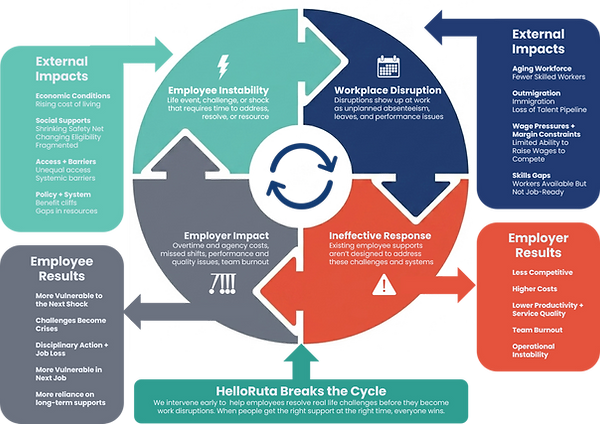
Workforce Instability is a Systems Problem
Workforce instability is often described through workplace metrics like absenteeism, turnover, overtime, and burnout. But these outcomes rarely begin at work. They begin when everyday life becomes difficult to navigate.
A transportation breakdown. A childcare disruption. A financial emergency. A housing challenge. A complex benefits application. On their own, these events may seem small. But when support is difficult to access, they can trigger a downward spiral that affects individuals, families, employers, and communities alike.
For employees, an unexpected challenge can lead to missed work, lost income, disciplinary action, and eventually job loss.
For employers, the same challenge appears as absenteeism, turnover, staffing shortages, overtime costs, and operational disruption. What looks like two separate problems is often the same underlying issue viewed from different sides of the system.
The problem is not simply a lack of resources. It is the lack of coordinated systems that make support accessible, actionable, and responsive when people need it most.
Our Systems Approach
Workforce instability is not an individual problem.
It is the predictable outcome of disconnected systems.
Most efforts to address absenteeism, turnover, and workforce disruption focus on symptoms after they appear. Employers respond to missed shifts. Service providers respond to crises. Public systems respond after someone becomes eligible for assistance. By that point, instability is already taking hold. We view workforce instability as the result of reinforcing cycles that connect economic conditions, social support systems, workplace practices, public benefits, and access to community resources.
When people encounter transportation challenges, childcare disruptions, financial shocks, housing instability, language barriers, or complex administrative systems, those challenges can quickly cascade into missed work, lost income, disciplinary action, and deeper instability.
At the same time, employers experience the same instability through a different lens: turnover, absenteeism, overtime, staffing shortages, burnout, and rising labor costs. As organizations become more strained, they often have less capacity to invest in employee support, creating additional instability across the system. The result is a self-reinforcing cycle that affects workers, employers, families, and communities alike.
HelloRuta intervenes by strengthening the connections between systems that are currently fragmented. We help employees access support before challenges escalate. We help employers understand and respond to the root causes of workforce instability. We help community organizations reach people more effectively. And we create opportunities for workers, employers, nonprofits, and community partners to share knowledge, identify barriers, and co-design solutions.
Our goal is not simply to solve individual problems. It is to strengthen the systems that shape workforce stability by improving coordination, increasing access, elevating lived experience, and creating feedback loops that help communities respond more effectively over time.
We believe lasting change happens when support becomes easier to access, organizations become more responsive to real-life needs, and the people closest to workforce instability help shape the solutions intended to address it.
How We Intervene
We Break the Cycle Before Challenges Become Crises.
HelloRuta was designed to intervene upstream. Rather than waiting until a missed shift, disciplinary action, leave of absence, or resignation occurs, we help employees access support when challenges first emerge. Through real-time navigation, practical assistance, community resources, financial guidance, and ongoing follow-up, we help people overcome barriers before they escalate.
At the same time, we help employers better understand the underlying drivers of workforce instability and shift from reactive crisis management to proactive workforce stabilization.
Our approach recognizes that workforce stability is not created by any single employer, nonprofit, government program, or community organization. It emerges when people can access the right support at the right time and when systems work together rather than in isolation.
What Comes Next
Building a Community-Powered Lived Experience Network.
HelloRuta was designed to help people navigate challenges in real time. But over time, we recognized a larger opportunity.
Many of the most effective solutions to workforce instability already exist within communities. Employees, caregivers, immigrants, parents, and community members develop practical knowledge every day about how to navigate transportation challenges, childcare disruptions, financial hardship, public benefits, housing instability, and other barriers. Yet that knowledge rarely reaches the people who need it most.
To address this gap, HelloRuta is developing an AI-powered community network for lived experience expertise. Through lived experience engagement, human-centered design, and community participation, we are creating a system where practical knowledge can be shared, validated, and scaled. Rather than relying exclusively on institutional expertise, this network will help workers, employers, nonprofits, and community members identify barriers, surface solutions, and contribute to more responsive workforce support systems.
We believe the people closest to workforce instability should help design the systems intended to address it. By combining professional support, community knowledge, and technology, we aim to create a continuously learning system that becomes more effective over time.
Intended Outcomes
Employee Stability
Helping people access support, maintain income, build resilience, and improve long-term economic mobility.
Employer Stability
Reducing preventable disruption, strengthening retention, and improving workforce participation.
Community Impact
Increasing utilization of existing services, improving coordination, and helping people access support earlier.
Systems Change
Shifting from fragmented, reactive responses to coordinated, proactive workforce stabilization.